
Circuit Breaker Size Calculator: The Homeowner's Complete Guide (NEC 2026)
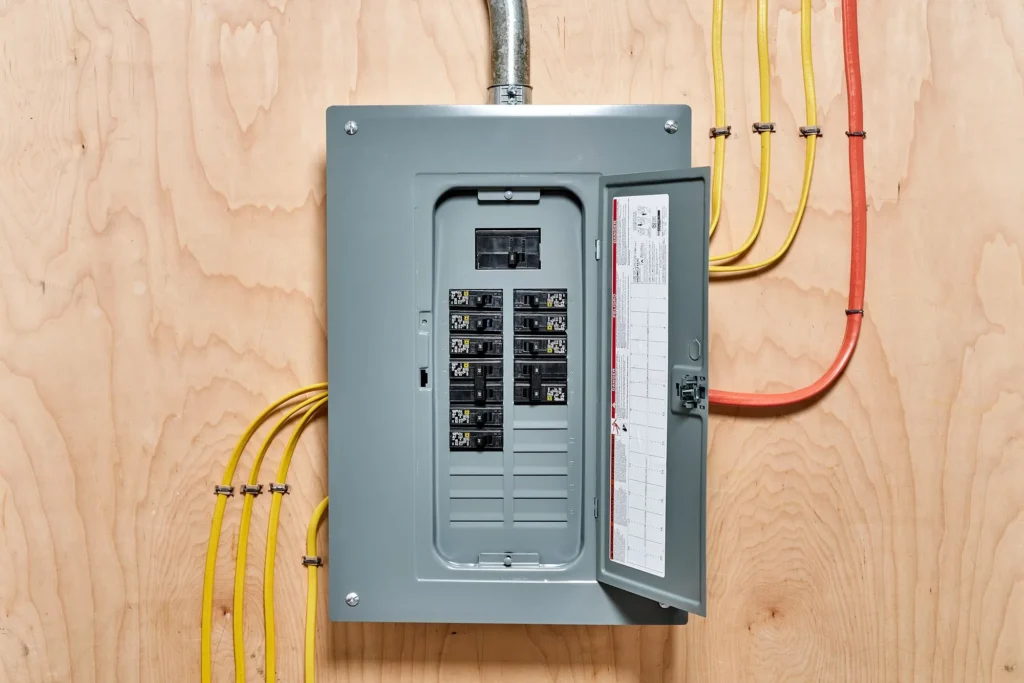
Most homeowners never think about circuit breakers — until something trips. But choosing the wrong size isn't just an inconvenience: undersized breakers trip constantly, and oversized breakers are a fire hazard. According to the NFPA, electrical failures cause roughly 13% of all US home fires each year. Proper breaker sizing is one of the simplest ways to protect your home.
This guide walks you through the NEC formula, a full sizing table for common circuits, the most dangerous mistakes to avoid, and answers to the questions electricians hear most often.
NEC Rule 210.20(a): A circuit breaker must be rated at 125% of the continuous load (any load running 3+ hours). This safety margin is mandatory — not optional.
Understanding circuit breaker basics
Circuit breakers serve as the first line of defense in your home's electrical system. They automatically shut off power when they detect an overload or short circuit, preventing wires from overheating and catching fire. Residential systems typically run at 120V for standard outlets and lighting, and 240V for heavy appliances like electric dryers, ranges, and air conditioners.
The fundamental NEC rule: size your breaker at 125% of the continuous load, or the conductor's rated ampacity — whichever is less. This safety margin prevents nuisance tripping while ensuring adequate fault protection.
Before adding any new circuits, it's also worth checking whether your panel can handle the additional load. Our Electrical Load Capacity Calculator can help you confirm your panel has room before you start.
How to calculate the right circuit breaker size
Sizing a breaker requires three inputs: total device wattage on the circuit, the circuit voltage (120V or 240V), and the NEC 125% multiplier. Here's the step-by-step process:
Standard residential breaker sizes are: 15A, 20A, 30A, 40A, 50A, 60A, 100A, 150A, 200A. Always round up to the next available size — never down.
Quick reference: circuit breaker sizing by appliance
Use this table as a starting point for the most common residential circuits. Always verify requirements with your local Authority Having Jurisdiction (AHJ) before installation.
| Circuit / Appliance | Voltage | Typical Load | Min. Breaker | Wire Gauge |
|---|---|---|---|---|
| General lighting / outlets | 120V | 1,200–1,440W | 15A | 14 AWG |
| Kitchen counter outlets | 120V | 1,800W | 20A | 12 AWG |
| Bathroom outlets (GFCI) | 120V | 1,440W | 20A | 12 AWG |
| Microwave (dedicated) | 120V | 1,500W | 20A | 12 AWG |
| Dishwasher | 120V | 1,200W | 20A | 12 AWG |
| Electric clothes dryer | 240V | 5,000W | 30A | 10 AWG |
| Central A/C (3-ton) | 240V | 7,200W | 40A | 8 AWG |
| Electric range / oven | 240V | 8,000–12,000W | 50A | 6 AWG |
| EV charger (Level 2) | 240V | 7,200W | 50A | 6 AWG |
| Hot tub / spa | 240V | 5,500W | 50A (GFCI) | 6 AWG |
Highlighted rows = circuits required by NEC in all new residential construction. Always verify with your local AHJ before installation.
Wire gauge matters as much as breaker size
A common and dangerous mistake is pairing a larger breaker with undersized wire. The wire must be rated to carry the breaker's full ampacity. If a 20A breaker protects 14 AWG wire (rated for only 15A), the wire can overheat and cause a fire before the breaker ever trips.
For a full breakdown of how to match wire sizes to circuits, see our Wire Size Calculator for Home — Free Tool & Complete Guide.
6 common circuit breaker mistakes homeowners make
1. Upsizing the breaker to stop trips
A 15A breaker that keeps tripping needs a load audit — not a bigger breaker. Swapping in a 20A breaker on 14 AWG wire is a code violation and a fire risk.
2. Ignoring the continuous load rule
Lighting in a workshop or kitchen runs continuously. The NEC 125% rule applies to any load running 3+ hours. Many DIYers skip this multiplier and end up with an undersized breaker.
3. Mixing wire gauges on a single circuit
Adding 14 AWG wire to an existing 12 AWG / 20A circuit can be done in limited scenarios — but extending a run with thinner wire downstream of the breaker is never acceptable.
4. Using two separate 120V breakers for a 240V appliance
A 240V circuit requires a double-pole breaker that connects both hot legs simultaneously. Two separate 120V breakers won't provide correct fault protection for 240V equipment.
5. Skipping AFCI/GFCI requirements
NEC 2023 requires AFCI protection on nearly all 15/20A circuits in living areas, and GFCI in bathrooms, kitchens, garages, and outdoor locations. Standard breakers won't meet code in these areas.
6. Not checking your panel's total capacity first
Adding a new 50A EV charger circuit to an already-loaded 200A panel can exceed your service capacity. Use our Electrical Load Capacity Calculator before installing any new major circuit.
Frequently asked questions
Can I replace a 15A breaker with a 20A breaker myself?
Only if the wiring on that circuit is 12 AWG or thicker. If the circuit uses 14 AWG wire (standard for 15A circuits), installing a 20A breaker is a fire hazard and a code violation. In many jurisdictions, panel work also requires a licensed electrician and a permit.
What is the difference between a single-pole and double-pole breaker?
Single-pole breakers protect one 120V hot wire and handle 15–20A loads for standard outlets and lighting. Double-pole breakers occupy two slots in your panel, connect to both 120V bus bars, and deliver 240V for large appliances like dryers, ranges, and A/C units. They also disconnect both legs simultaneously during a fault.
Why does my correctly-sized breaker keep tripping?
Common causes include a faulty or aging breaker that trips below its rated amperage, a loose connection or wiring fault causing heat buildup, a motor-driven appliance drawing high inrush (startup) current, or a genuine overload requiring the circuit to be split. If a new correctly-sized breaker still trips, have a licensed electrician inspect the wiring.
Are AFCI breakers actually required, and how much do they cost?
NEC 2023 requires AFCI breakers on virtually all 15A and 20A branch circuits in living areas of new construction. They typically cost $35–$65 each, compared to $5–$15 for standard breakers. Check with your local building department to confirm which NEC edition your jurisdiction has adopted.
How do I know if my 200A panel can handle a new EV charger?
A Level 2 EV charger typically needs a dedicated 50A/240V circuit. To check available capacity, total up all existing double-pole breaker amperage plus the new 50A circuit, and compare against your service rating. Our Electrical Load Capacity Calculator walks through this calculation step by step.
Related calculators you may find useful: