
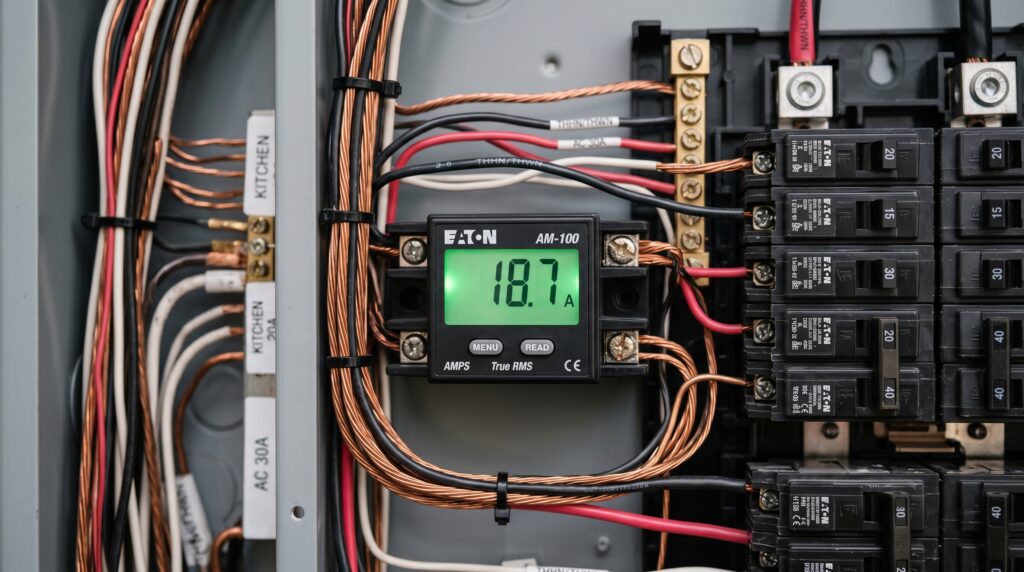
Convert watts to amps instantly with our free watts to amps calculator. Perfect for US homeowners and electricians sizing circuits, breakers, and wire gauges safely.
Understanding how to convert watts to amps is one of the most important electrical skills for US homeowners and electricians. Whether you’re installing a new appliance, upgrading your electrical panel, or troubleshooting circuit breaker problems, knowing how watts and amps relate to each other could save you money and prevent dangerous electrical hazards. A watts to amps calculator for home use makes this conversion quick and accurate, and today we’ll explain exactly how it works and why it matters for your household electrical system.
Why You Need a Watts to Amps Calculator for Home Use
Your home runs on two standard voltage systems: 120V for most outlets and small appliances, and 240V for larger appliances like electric water heaters, air conditioners, and dryers. When you read an appliance’s power rating in watts, you need to convert that to amperage to determine the correct circuit breaker size, wire gauge, and safety margins required by the National Electrical Code (NEC).
Converting watts to amps manually requires the basic formula: Amps = Watts ÷ Volts. However, manually calculating this for every appliance in your home is time-consuming and prone to errors. A watts to amps calculator eliminates guesswork and helps you make safe, code-compliant electrical decisions. Additionally, understanding this relationship prevents you from accidentally overloading circuits, which is a leading cause of home electrical fires.
According to the National Fire Protection Association (NFPA), electrical and lighting equipment failures cause approximately 13% of reported home fires annually. Proper circuit sizing using a watts to amps calculator is a critical safety step every homeowner should take.
How to Use a Watts to Amps Calculator Step by Step
Using a free watts to amps calculator is straightforward, but you’ll want to gather the correct information first. Start by locating your appliance’s wattage rating, which is usually printed on a label on the back or bottom of the device. Common US home appliances typically draw between 500 watts and 5,000 watts.
Next, identify the voltage at which your appliance operates. In the United States, standard residential voltage is either 120V (most outlets) or 240V (dedicated circuits for major appliances). Your appliance nameplate will clearly indicate which voltage it requires.
Once you have both values, enter them into the calculator. The tool instantly displays the amperage draw. For example, a 3,600-watt electric water heater on a 240V circuit requires 15 amps (3,600 ÷ 240 = 15 amps). However, per NEC code, you must apply the 125% rule for continuous loads and size your breaker and wire accordingly, which our free watts to amps calculator at myelectriccalc.com handles automatically.
Understanding Common Home Appliance Amperage Requirements
Different appliances demand different amounts of current. Understanding typical amperage ranges helps you plan your home’s electrical upgrades intelligently. Here are the most common household appliances and their approximate amperage requirements at standard US residential voltages:
- Ceiling fans typically draw 0.5 to 1.5 amps at 120V, making them compatible with standard 15-amp circuits shared with other light-duty devices.
- Microwave ovens typically consume 10 to 15 amps at 120V, which is why they require a dedicated 20-amp circuit per NEC code.
- Air conditioning units usually require 15 to 25 amps at 240V, necessitating a dedicated circuit and appropriate wire sizing to prevent voltage drop.
- Electric water heaters demand 30 to 50 amps at 240V, requiring dedicated 40-amp or 50-amp breakers and heavy-gauge wire like 6 AWG or 8 AWG copper.
- Range and oven appliances typically draw 40 to 50 amps at 240V, requiring the largest standard residential breaker sizes and thicker wire gauges.
- Refrigerators typically use 6 to 8 amps at 120V, though they should have their own dedicated circuit to prevent nuisance breaker trips.
These ranges show why proper calculation is critical. A miscalculation could result in undersized wiring that overheats, or an undersized breaker that trips constantly. Conversely, oversizing components wastes money unnecessarily. Using a watts to amps calculator ensures you match the right breaker size and wire gauge to each appliance.
The Relationship Between Watts, Amps, Volts, and Power Factor
The basic formula Amps = Watts ÷ Volts works for resistive loads like heaters and incandescent lights. However, motor-driven appliances like refrigerators, air conditioners, and washing machines introduce a factor called power factor. Power factor accounts for the phase relationship between voltage and current in AC circuits. For most household motors, power factor ranges from 0.85 to 0.95, meaning you’ll actually draw more amps than the simple formula suggests.
A quality watts to amps calculator accounts for power factor automatically, giving you accurate real-world amperage. Furthermore, the NEC requires applying a 125% safety multiplier to continuous loads (loads running three hours or more). This means that a 20-amp calculated load must be protected by a minimum 25-amp breaker. These nuances are why professional-grade calculation tools are invaluable, and why consulting the Electrical Load Calculator: Size Your Home’s System (2026) is recommended for whole-home planning.
Wire Gauge Selection Based on Amperage
Once you know the amperage requirement, you must select the correct wire gauge. The NEC sets specific standards for wire sizing based on the amperage and the type of insulation. Using undersized wire is dangerous and violates electrical code. Here are the standard residential wire gauges and their ampacity at 60°C insulation:
- 14 AWG copper wire safely carries 15 amps maximum and is used for standard lighting and outlet circuits protected by 15-amp breakers.
- 12 AWG copper wire safely carries 20 amps maximum and is used for kitchen countertop outlets, bathroom outlets, and dedicated appliance circuits protected by 20-amp breakers.
- 10 AWG copper wire safely carries 30 amps maximum and is used for air conditioner circuits, electric range circuits, and water heater circuits protected by 30-amp breakers.
- 8 AWG copper wire safely carries 40 amps maximum and is used for large appliances and dedicated high-current circuits protected by 40-amp breakers.
- 6 AWG copper wire safely carries 55 amps maximum and is used for the largest residential appliances and sometimes for feeder lines to sub-panels.
A watts to amps calculator combined with knowledge of these wire standards ensures you never make a dangerous wiring error. For detailed guidance on wire sizing, check out the Wire Size Calculator for Home | Free Tool & Complete Guide to confirm your selections.
Planning for Future Electrical Upgrades and EV Charging
Modern homes increasingly add electric vehicle charging stations, which represent a significant electrical load. A Level 2 EV charger typically requires 30 to 50 amps at 240V, comparable to an electric range. As a result, planning your home’s electrical capacity using a watts to amps calculator becomes even more critical as you consider future upgrades.
If you’re planning to install an EV charging station, consult the